San Francisco History Center's Alien Enemy Registration Affidavits

Alien Enemy Registration Affidavit, 1918. SF History Center
The San Francisco History Center of the San Francisco Public Library is the archives for the City and County of San Francisco. Formed in 1964 as the Californiana Collection, the current San Francisco History Center holds a comprehensive, non-circulating research collection covering all aspects of San Francisco history (and, to a lesser extent, California and Western history) from the time of the area's earliest habitation to the present day. The material sheds light on many aspects of the City's history: its geography and architecture; its politics and government; the lives of citizens, both prominent and ordinary; and, the contributions of ethnic, cultural and social groups in creating the City's vibrant character.

The mission of the San Francisco History Center is to illuminate the founding, growth and development of the City by providing primary and secondary resources.
Located on the 6th floor of the Main Library, the Center serves all library users and levels of interest, from the merely curious to those engaging in scholarly research.

In keeping with the theme of Im(migration) and Indigenous Voice of California, the San Francisco History Center will be sharing resources from several collections, which include Paul Radin Papers (SFH 23), Alien Enemy Registration Affidavits, 1918 (SFH 48), Maxine Gonong Papers (SFH 59).

For this post, the spotlight is on the Alien Enemy Registration Affidavits.

Alien Enemy Registration Affidavit SF History Center


On November 16, 1917, all males in the United States older than 14 who were "natives, citizens, denizens, or subjects" of the German Empire were required to register as alien enemies. In 1918, an act of Congress included women aged 14 and older. The U.S. Attorney-General requested that the San Francisco Police Department administer the regulations under the general supervision and direction of the United States Department of Justice. Registration affidavits were filed at police district stations. Then each district sent its collected registration affidavits along with a summary sheet to the Chief Registrar. Each "alien enemy" was issued a registration card with photograph and identifying information, which he was required to have on his person at all times. He also needed permission from the
local registrar to travel or change place of residence. Certain areas were
also off-limit zones as deemed by the military. The Armistice was declared on November 11, 1918, and all regulations on enemy aliens were lifted December 25, 1918.


Alien Enemy Registration Affidavit SF History Center
Registration affidavits are 4 pages in length and include the following information: name, maiden name, address, length of residence in San Francisco, birthplace and date, all employment and residences since January 1, 1914, date and port of arrival in United States, ship's name, name of person who supported entry (sponsor), names of parents, parents' birthplaces, registrant's marital status, name of spouse, names and birth dates of children, whether or not registrant had family members in arms against the US, military service, naturalization information, arrest
information, physical description, photograph, signature, and fingerprints. Alien female forms also requested names, birth dates, and residences of all brothers and sisters, and languages spoken, written and read.


*********************************************************************************


No Registration Necessary! How to have the best Archives Crawl on October 13


On October 13, we will host guests from all over the Bay Area, excited to see collections related to the theme, Immigration and Indigenous Voices of California. So how can you best enjoy the Crawl. Here are some tips for your day:

  • Take Public Transportation from location to location, or walk if you can. The night before, review travel and public transportation routes to ensure you get to each location, or the one of  your choice on time!
  • Talk to the archivists and librarians! Each one has immense expertise and wants to share facts and histories behind what they are showing.
  • Ask an archivist what you can hold, take photos of, or just look at. Some of the collections at the Crawl will be fragile, and many will be 50, 100, or 100+ years old. Remember to be careful with what you do touch since we want to ensure that guests years from now can experience these powerful items.
  • Have fun!
Citation: Miss Cable's class of Chinese girls, circa 1882 (First Presbyterian Chinese Church), San Francisco Subjects Photography Collection, PC-SF_00022.

Photographs of Unknown Women

Digger Indian Squaw. Lawrence & Houseworth Albums, 1860-70.

Mrs.Chas.McLaughlin, c. 1875. Bradley & Rulofson, San Francisco.
Albumen Print


The many women members of the Association of Pioneer Women, whose stories and ancestors were preserved in their "History Book", have nearly no visual records of who they were. A few of the women we found an image for in our photography files, but for the most part - nothing was found.
But, in our photography collection, there are many women of which we have photographs, but no names.

The top photograph shows an Indian woman, described as a squaw - therefore a wife, or just a woman - but no name was assigned to her photograph. Photographers Lawrence and Houseworth took photographs all over California during the years between 1860 and 1870. Their photographs of cities, streets, mountains, rivers and gold mining towns were all identified - but Indian women were not.

The bottom photograph, of Mrs. Chas.McLaughlin, is not exactly anonymous, but is identified only as the "Mrs." of "Chas. McLaughlin".  Bradley & Rulofson were preeminent photographers in 19th century San Francisco, taking the photographs of many of the wealthier residents in the city. This woman - with her elaborate hairdo, beautiful clothing and hand-colored embroidered shawl, identifies her as a woman of upper class San Francisco. But, a first name she does not have.

At the Archives Crawl on Saturday, October 13, there will be various types of photographs on display: card photographs, prints and photo albums. In addition to photographs - you will see Gold Rush Letter-sheets, maps, and artifacts women would have carried with them across the Plains and around the Horn.

Looking forward to seeing you on Saturday!


Quilt, 19th century
One-Patch: Half-Square Triangles
Cotton and batting
Seamstress unknown

"We lost one of our party by death in this region. They wrapped him in a quilt, dug a hole in the ground and covered it with earth."

~ Harriet Zumwalt  Smith

Born in Bolivar, Missouri, left for California on May 1st, 1849 arrived in California in October 1849

Quilts came to California by as many routes as the pioneers. By wagon, by ship around Cape Horn and by ship and steamer via the Isthmus of Panama. 
The quilts themselves were made of fabrics as varied as their means of arrival.
Upon reaching California, the materials needed to produce a quilt were not always available.
Needles, pins, thread and small scissors, were carried with them on their journey, but pieces of cloth were often traded for with new neighbors, purchased in the newly minted general merchandise stores, and even salvaged from ship wrecked trunks of other travelers.

Harriet Zumwalt, she later married Mr. Smith, came to California as a young child. Her recollection, in the History Book of the Association of Pioneer Women of California, relates some incidents of her journey to California by wagon. She notes that one man died of cholera on the way, and his wife and children went back to Missouri. Indians were always present, but not always a problem. River crossings were dangerous - horses, men and wagons were lost in the strong currents. 
The account notes that the region of the Green River (in what is now Wyoming) was particularly dangerous, and there they lost one of their party - a coffin was not to be found, so one of their precious quilts was used to provide a somewhat decent burial for the man.

Please visit us on October 13, between 1 and 5pm, for the San Francisco Archives Crawl.
One other quilt will be on view - the Cross Plains Star. 

Cataloging & Conserving What They Carried:The Geneva Bible

Next month's #SFArchivesCrawl's theme is Im(migration) and Indigenous Voices of California.  We at the Sutro Libray have decided to focus on the things that travelers brought with them when they traveled. We have many physical reminders of people's past journeys: government documents, diaries, maps, guidebooks, letters, and books.  One item that traveled relates strongly to the upcoming 400th anniversary of the Mayflower's voyage and colonization of the area known today as New England.

The participants of the Mayflower journey are credited with taking a particular version of the Bible with them to the new world. It’s known as the Geneva Bible, in honor of the very active community of Protestants in the city where it was printed. It predates the more famous King James Version (which Sutro also has) and continued to be produced for some years before being practically supplanted.

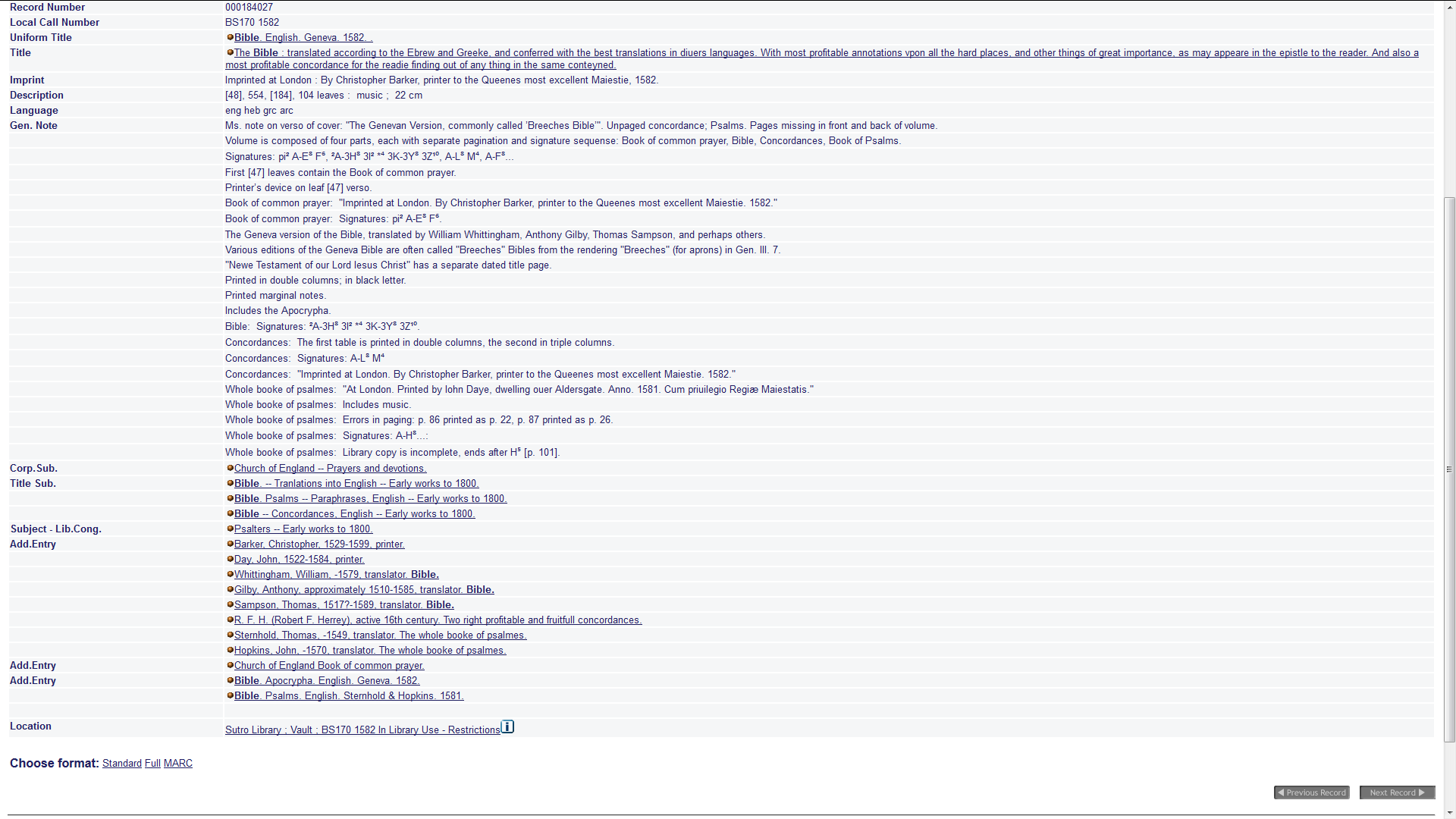
The Sutro Library owns a 1582 imprint of the bible which was originally printed in 1560. This later printing demonstrates two significant differences from the earlier one. The first printing was printed in Roman type, while our version is printed in black-letter. However, the more commonly ascribed difference is the use of the word ‘breeches’ to describe the plant based clothing Adam and Eve used to cover themselves.  This printed edition among Geneva Bibles is known as the Breeches Bible.

Breech1

There were multiple additional features which appeared in the printed text. Glosses, illustrations and more gave the reader a more direct understanding of the scriptures. In this period literacy and printing was empowering individuals to make decisions about their own faiths and directly challenged the authority of the priestly classes.
Our book includes 3 other works: Whole Booke of Psalms, printed in 1581; Concordances, printed in 1582; and the Book of Common Prayer, printed in 1582.
As you can imagine, cataloging a work of this historical importance and complexity is a significant challenge. Have a look at the deluge of notes in the record:

breech2

The devil is in the details, so without the careful work of an expert cataloging librarian, researchers would lack the information they need to identify materials of interest remotely. We are most grateful to our expert cataloger, Dan Taysom, for creating this amazing record for this special item.
Another perennial problem is condition. After 436 years of use, anyone would look a bit tired! We sent the volume in its tattered state to a professional conservator for treatment. Our priority as custodians is to ensure that materials continue to be accessible for hundreds of years into the future.

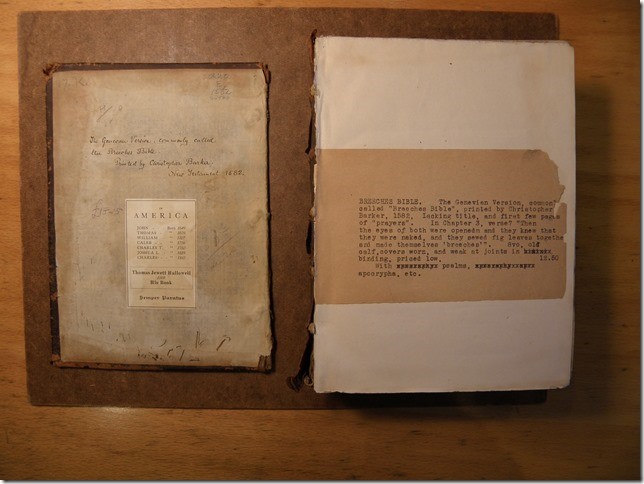
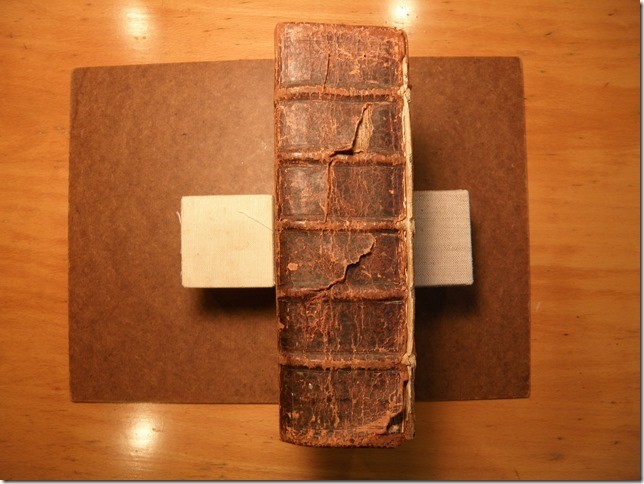
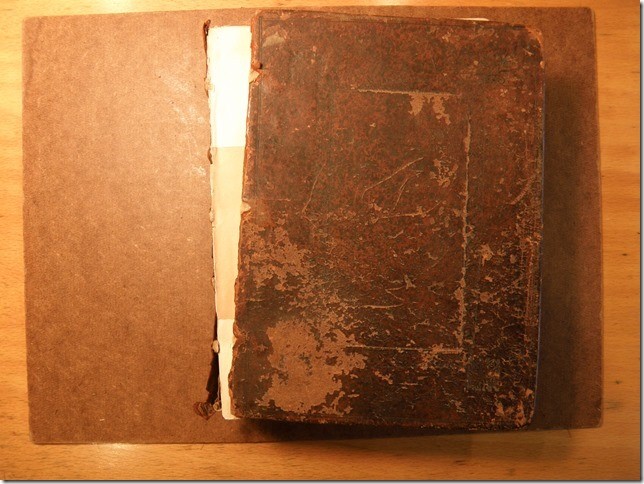
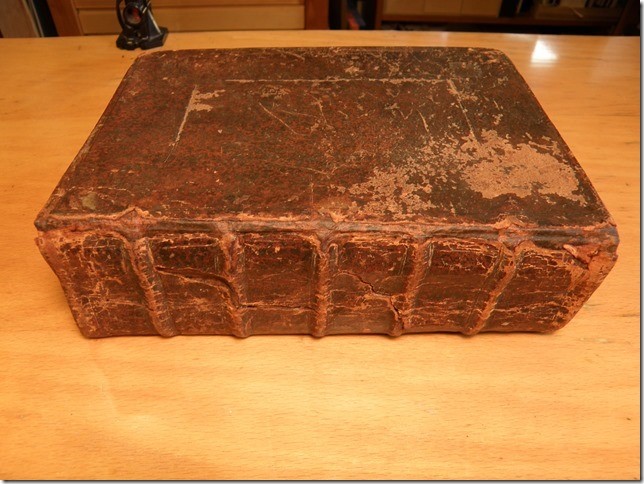
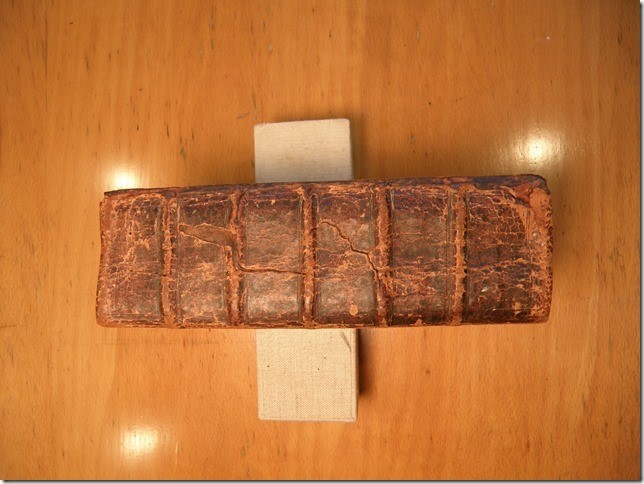
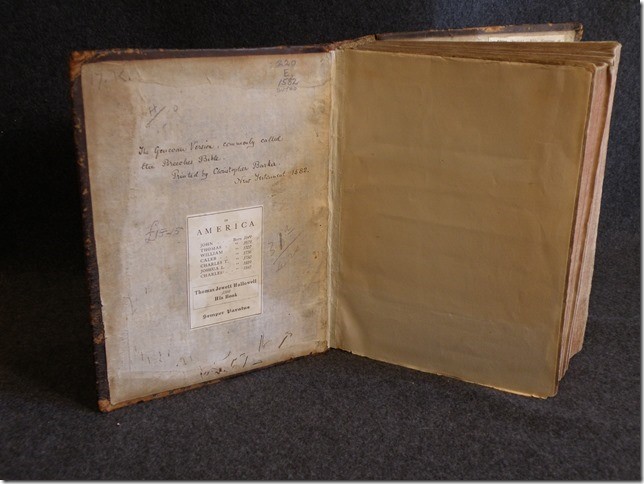
Here is the bible before conservation treatment:

breech5breech4breech3

As you can see, the way the binding is damaged makes it very difficult to use. Handling a book in this condition will often result in further damage. It’s the conservator’s job to stabilize the binding, effect any necessary or integral repairs, but not necessarily hide the repairs or erase some of the books history. Restoration is the process of making something old look like-new. Conservation is the process of stabilizing something so that it will be usable, but maintaining whatever features have been added or changes which have occurred over time.

Here is the bible after treatment:

breech8breech7breech6

If you’d like to see this bible, or any other items from Adolph Sutro’s rare book collection, please email sutro@library.ca.gov or call 415-469-6100 to schedule an appointment. Make sure you mention the call number for this book: BS170 1582.

We wish to thank the California State Library Foundation for funding the conservation work on this bible and Sarah Elson of Sarah Elson Bookbinding, Menlo Park, for the pictures submitted for this article and for her outstanding conservation work.

[Originally published on the Sutro Library blog. This article was written by Sutro Library Librarian, Colyn Wohlmut, who has since assumed a new position at another institution. We wish her every success!]